

 Brett Warren , National Director – Metropole Group
Please use the menu below to navigate to any article section:
Does it feel like your money isn’t working as hard as it used to?
Costs are up, growth has stalled, and the “just wait, and it’ll go up” strategy has gone quiet – you’re not imagining it.
We may not be staring down a repeat of the 1970s, but we are living through the same combination of forces that defined that decade: sticky inflation, higher-for-longer interest rates, and precious little capital growth to show for it.
That combination has a name – Stagflation.

What Stagflation Actually Means
In simple terms, stagflation is the simultaneous occurrence of high inflation, stagnant economic growth, and rising unemployment.
It’s the scenario economists spend most of their careers hoping never to encounter, because the usual fiscal tools don’t work well.
You can’t cut rates to boost growth without reigniting inflation, and you can’t raise rates to fight inflation without further choking growth.
The only viable option is usually a series of rapid and simultaneous rate rises, which isn’t good for anyone.
The good news is that we’re not at the 1970s extremes. Back then, US inflation ran near 13% and unemployment approached 9%.
Today we’re sitting at roughly half those levels, but half a crisis is still uncomfortable, and the underlying mechanics are eerily familiar.
The 1970s Playbook, Rerunning in the Background
A few parallels are worth mentioning because they explain why this environment has formed, rather than merely describing that it exists:
- Oil price shocks. The 1970s saw oil embargoes that quadrupled prices overnight. Today’s shock is more contained, but tension in the Middle East means energy security remains a live risk, sitting in the background of every inflation forecast.
- Loose policy in the prior cycle. The 1970s inherited loose fiscal and monetary settings from the Vietnam-era economy. We inherited something similar from COVID – extraordinary government stimulus, cheap money, and a household sector that used it to buy boats, caravans, houses, and pay down debt. Necessary at the time, but it built the inflationary pressure we’re now unwinding.
- Wage-price dynamics. Wages aren’t keeping pace with the cost of living, purchasing power is being squeezed, and productivity isn’t picking up the slack. Every dollar spent isn’t generating the output it used to, particularly in the public sector.
- A structurally low-growth window. Whatever you call it, the next two to three years are shaping up to be short on capital growth and long on holding costs.
The point isn’t to panic about a repeat of the 1970s. It’s to recognise that the investment playbook that worked for the last decade – buy, hold, let growth do the work – needs a rethink and fast.
The Double-Edged Sword of Inflation for Property Investors
Now, just to be clear, inflation isn’t necessarily bad news for property investors. It can actually work in your favour, but it has limitations.
Property is a traditional inflation hedge. Over time, rents and values tend to rise alongside inflation.
And there’s a quieter but very powerful benefit most investors overlook: inflation erodes the real value of debt.
If you’re holding a $1 million loan and inflation runs at 6% for the year, the real value of that debt has fallen to about $994,000 by year’s end.
That’s part of why governments are comfortable with the level of inflation, as it quietly pays down their debt for them.
Property investors with the right strategy and structure can benefit from the same outcome.
The catch is the standard policy response to inflation: rapidly rising interest rates.
And that’s what cools the market, pushes up borrowing costs, and squeezes property investors who can’t keep pace, turning the same inflationary environment that should help them into one that threatens to sink them.
The challenge is clear: you need an asset that earns its place on both sides of the ledger.
It has to hedge against inflation on the way up, without being smashed by the rate cycle that’s fighting that inflation.
The Short-Term Reality
Let’s be honest about where we sit right now:
- Property prices are flat to falling in many markets
- Capital growth has slowed or reversed
- Holding costs and rates are meaningfully higher and rising
- Wage growth isn’t matching cost-of-living increases
However, in this environment, the solution isn’t to abandon capital growth and chase pure cash flow assets.
It’s to buy high-capital-growth assets that carry a strong cash flow element in the short term – enough income to bridge you through the low-growth years until the next growth phase kicks in.
This is where the investment-grade apartment conversation starts to get interesting.
Is an Investment-Grade Apartment the Cure?
To be clear about what “investment grade” means in relation to apartments – it’s not in a 100-unit tower on a main road with a pool, gym, and sauna.
It’s in a smaller, boutique complex in a genuinely undersupplied, high-demand location – the kind of asset where scarcity does the heavy lifting.
When you look at the supply pipeline across our major capital cities over the next five years, a clear gap emerges between what’s being built and what’s actually needed.
That gap does three things at once: it drags vacancy rates down, pushes rental prices up, and puts sustained upward pressure on values.
The numbers back it up:
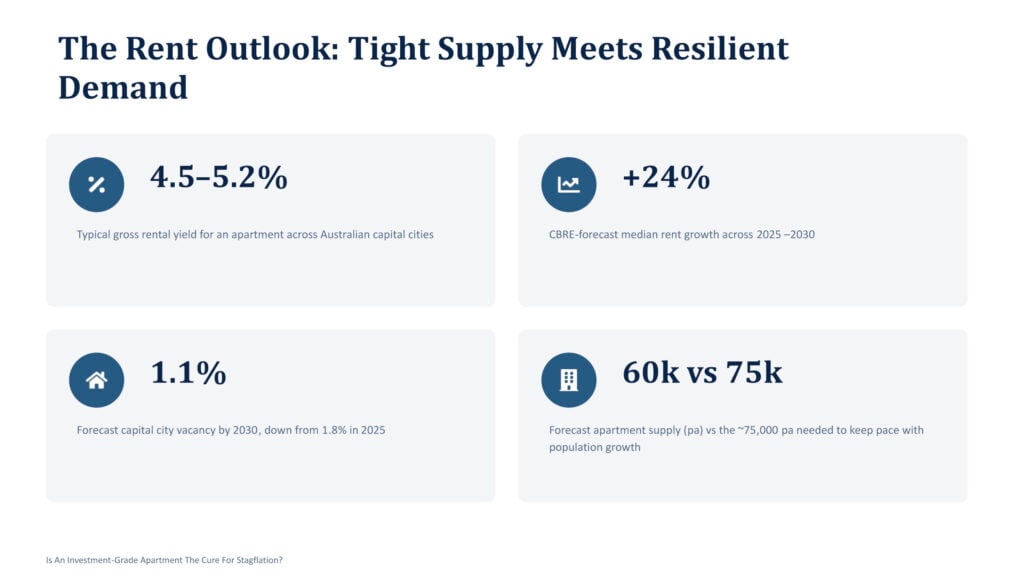
- Sydney needs roughly 30,000 new apartments a year but is delivering around 11,500 – less than half of underlying demand
- Melbourne’s delivery is running around 25% below Sydney’s, against the largest demand pool of any state – annual demand sits near 15,000 apartments, with only about 7,000 being built
- Brisbane is already in an advanced, landlord-favourable position, with vacancy rates set to tighten from 1.1% to as low as 0.7%
And government “build-to-rent” initiatives, however well-intentioned, are a five-to-ten-year fix at best, meaning they won’t move the needle on the supply gap over the next three to four years.
There’s also a yield story hiding in plain sight: 242 suburbs across Australia currently offer 5%+ rental yields on units, compared to just 40–47 suburbs offering the same for houses.
For investors who can’t stretch to a house, this is a genuine entry point – one that helps cover holding costs now while you wait for the next growth cycle.
For Higher Net Worth Investors: Two Ways to Play It
The passive approach – owning a small boutique apartment block in blue-chip, land-constrained locations.
We’ve recently placed clients into exactly this kind of asset in Melbourne, a few streets from the water, in the $3 million range, bought effectively at land value.
Compare that to commercial property yields currently sitting around 5–5.5% (and likely to tighten further as vacancy falls), you’re getting comparable cash flow with the long-term capital growth profile of residential, not commercial.
These properties are typically being bought at 30% or more below replacement cost – what it would actually cost to acquire the land and build today.
Many are older, tired stock (art deco blocks are my personal favourite) with genuine renovation upside: bring them back to life, and you can reopen depreciation benefits that further close the cash flow gap.
The active approach – buy a tired, “past its use-by date” property, remove the existing house, and build two brand-new dwellings in its place.
This is where you stop waiting for the market to do the work and start “manufacturing” equity yourself.
At the end of the project, you get premium rents, fresh depreciation schedules, and negative gearing benefits across two assets rather than one – the closest thing to a “high-growth, high-cash-flow” unicorn this market offers.
It’s not cheap – projects like this can run $2.5–3 million – which is why joint ventures are becoming a bigger part of the conversation.
Pairing investors together to combine capital, share the development, and split two finished properties at the end is a structure worth watching over the next 12 months.
Something Metropole will offer in the new year.
The Bottom Line
There’s no single cure for stagflation. But there is a prescription.
Investment-grade apartments hedge against inflation on the way up, but only if the cash flow genuinely aligns with the environment you’re investing in.
Right now, the rental returns available on well-located apartments outstrip almost anything else on the market.
A structural supply gap across every major capital means today’s tight conditions are setting up the market for the next growth phase.
For investors with the capital and appetite to be more active, buying below replacement cost and building manufacturing equity through renovation or redevelopment lets you create growth the market isn’t currently handing out for free.
This stage of the cycle rewards the investor who stops waiting for the market to do the work, and starts building the cash flow that buys them the time to win anyway.
While others retreat after Budget changes, smart investors are creating opportunities.