


 Brett Warren , National Director – Metropole Group
Please use the menu below to navigate to any article section:
- Change the order: earn, spend, then pay tax
- The two taxes every investor pays — and why timing changes everything
- Deductions, negative gearing and the traps to avoid
- The hidden costs: budget up to 5% on top of the price
- Model every deal conservatively and protect your buffer
- Where property returns really come from
- Why a lower headline return can win
- Not all debt is bad debt
- Why capital growth wins in the end
- The bottom line: know your numbers before you dip your toe in
Thinking of buying a property and don’t know the numbers?
Given the current tax changes and economic environment, you’re not investing — you’re gambling.
With negative gearing and capital gains tax both changing, the gap between investors who run the numbers and those who don’t is about to get much wider.
That is why it is even more critical you consider how tax really works for property investors, why compounding is your most powerful ally, the hidden costs that catch people out, and how to set up your finance so you can keep growing.
There’s a great line from Zen teacher Shunryu Suzuki Roshi that I love: “In the beginner’s mind there are a few possibilities, but in the expert’s there are many.”
The best investors never lose that open, curious mindset and, as a result, see many possibilities.
The more you keep learning, the more opportunities you start to see around you, so let’s start considering more of these possibilities.

Change the order: earn, spend, then pay tax
Most salary earners pay tax first and live on what’s left.
Strategic investors flip the order: they spend on legitimate, deductible expenses first, then pay tax on the remainder.
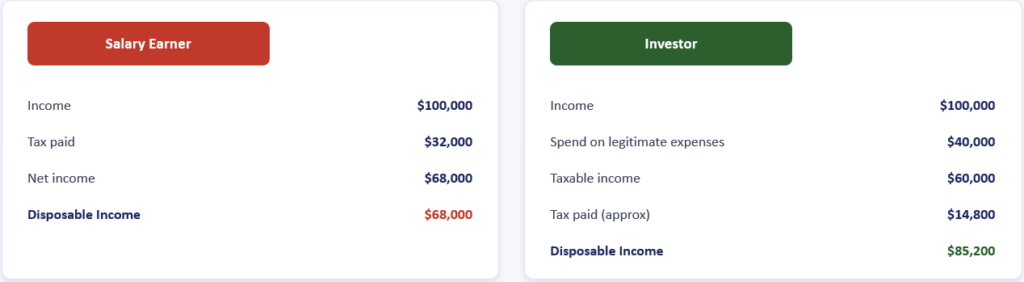
Same income, roughly $17,000 less tax.
And no, “legitimate expenses” doesn’t mean jet skis and overseas holidays, for property investors it means interest, depreciation, maintenance, property management and the like.
A word of caution though: tax should never be the primary reason you buy a property, plenty of people get into property for the tax break, and that’s the wrong starting point.
Buy the right asset first; the tax benefits become the icing on the cake.
The two taxes every investor pays — and why timing changes everything
Every property investor deals with two taxes:
- Income tax on your rental income (just like your salary), less your legitimate deductions.
- Capital gains tax when you sell.
CGT is changing significantly. From 1 July 2027, the 50% CGT discount is being replaced with cost base indexation and a 30% minimum tax rate on real capital gains.
Sell before then and the old rules, including the 50% discount, still apply.
But here’s the bigger lesson: The most successful investors I know seldom or rarely sell.
They hold for as long as possible and only pay CGT when they eventually sell, which means their wealth compounds tax-free in the meantime and that changes everything.
Consider a simple thought experiment: one dollar that doubles every year for 20 years.
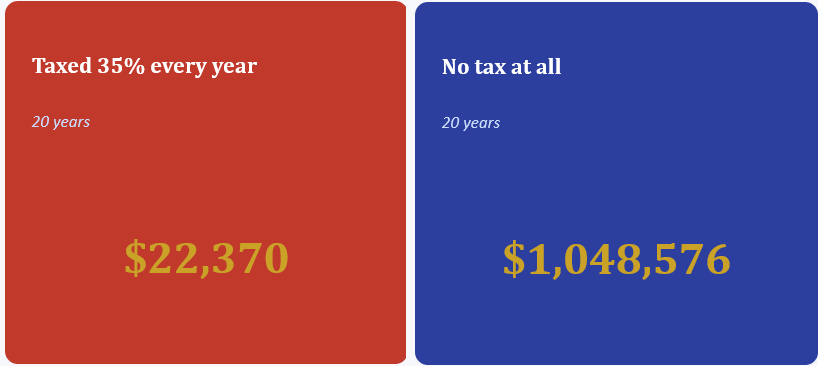
No real asset doubles every year, of course, but the principle holds: deferring tax lets the full amount keep compounding, year after year.
Even after paying 35% at the end, you finish roughly 30 times better off than paying tax every year.
That’s exactly how everyday Australians build multi-million-dollar portfolios: buying well, holding and compounding over decades… not years.
Deductions, negative gearing and the traps to avoid
The everyday deductions available to property investors include:
- Interest on your investment loan (not the principal)
- Insurance, agent fees, maintenance and repairs and other running costs
- Depreciation: older buildings have little left to claim, so we usually model it at zero. Newer properties let you depreciate the building and, in the early years, the fixtures and fittings too
- Negative gearing: still available on grandfathered properties, but for established properties bought after the Budget, losses will no longer offset your wages under the new rules
Negative gearing is a genuine benefit, especially with cost-of-living pressures and higher interest rates, but there’s the catch: it only works if the property grows strongly.
If your property only grows at 3–4% a year, as some did between 2010 and 2020, it can cost you more to hold than you may ever get back.
The four traps that turn negative gearing into a money pit:
- Poor capital growth: choose the wrong asset and the maths never works
- Rising interest rates: more increases are likely, so build them into your numbers
- Poor rental growth: buy where rents will keep rising faster than inflation, not just with it
- Lack of financial discipline: never raid your buffer. Taking a couple of thousand out here and there feels harmless until the market shifts, and as the last few years have shown, it can shift fast
Many investors underestimate what it actually costs to buy a property.
Allow up to around 5% of the purchase price for:
| Cost | What to know |
| Stamp duty | Varies widely by state. Victoria’s is higher than most, so model the state you’ll actually buy in |
| Land tax | Also varies by state. Don’t run your numbers on a Queensland purchase, then buy in Melbourne and get caught out |
| Conveyancing and legal | Skip the bottom-of-the-barrel option. Aim between a mid-range conveyancer and a solicitor: roughly $1,500–$2,500 |
| Finance costs | Applications, valuations and other lender fees; most should be outlined up front |
| Lenders mortgage insurance | Usually applies when borrowing over 80%. On an investment loan it’s generally claimable as a borrowing cost; check the treatment with your accountant |
| Inspections and reports | Building and pest, strata reports, and a due diligence report for any development |
It all adds up quickly, which is why you get the numbers right before you do anything.
Model every deal conservatively and protect your buffer
Before we buy anything, we model it in detail.
Here’s how we approach an $850,000 purchase:
- Include every cost: all the purchase costs above, plus a buyer’s agent if you use one
- Be conservative on growth: Australian property has averaged a little over 7% a year. We take about 1% off and model established properties at around 6–6.5%, and new properties lower again
- Allow 25–35% of rent for expenses: if your rental expenses come in lower, you’ve probably missed something, such as land tax or regular maintenance. You might not spend $1,000 each year, but when a $5,000 job arrives in year four or five, it evens out
- Factor in depreciation and tax credits honestly, based on the property you’re actually buying
In our example, with 100% borrowing, the property costs roughly $300 a week (about $15,500 a year) to hold after negative gearing and depreciation, which together are worth around $23,000 a year in tax credits.
Now take those benefits away, as will happen for an established property bought after the Budget and the pre-tax holding cost jumps to about $38,500 a year, roughly two and a half times as much.
You can still claim those losses in future, but it could take 7–10 years for the property to reach positive cash flow and trigger your ability to recoup.
That’s exactly how buffers can disappear into thin air in a matter of years.
Also, BEWARE of anyone showing you projections of 10% growth and 10% rent increases every year for 20 years, that’s a farce and too good to be true.
Where property returns really come from
Property returns come from four sources:
- Capital growth: the big one. Aim for above-average, wealth-producing growth by buying in the right place at the right time
- Cash flow: rental income, ideally where a shortage of properties means rents grow faster than average
- Equity gains you create: property is one of the few assets where you can add value yourself. Paint, renovate, rebuild and lift the rent and claim the depreciation
- Tax benefits: the deductions and deferrals covered above
To compare property fairly against shares or a term deposit, we use the internal rate of return (IRR).
It combines every inflow and outflow (deposit, costs, rent, growth and tax) into one percentage.
Why a lower headline return can win
| Asset A: property | Asset B: shares | |
| Annual growth | 7% | 9% |
| Yield | 4% | 5% |
| Typical borrowing | 80–90% | around 50% |
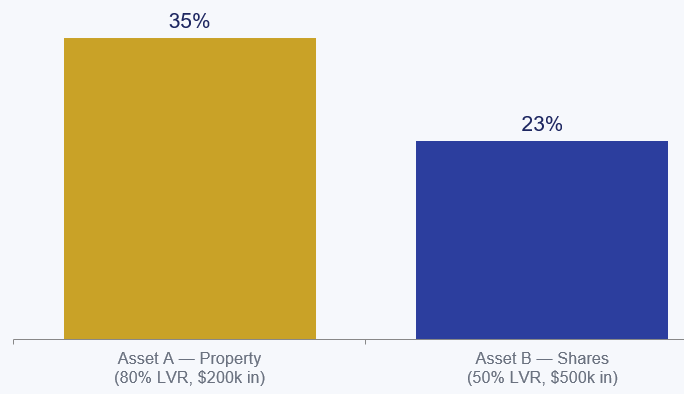
On the headline numbers, Asset B clearly looks better, but because you can leverage and borrow far more against property, Asset A puts more money to work for every dollar you contribute.
More leverage means more compounding, and a higher return on your money, that’s what we’re really after.
To match a property delivering a 20% IRR, a bank deposit would need to pay around 30% before tax.
Not all debt is bad debt
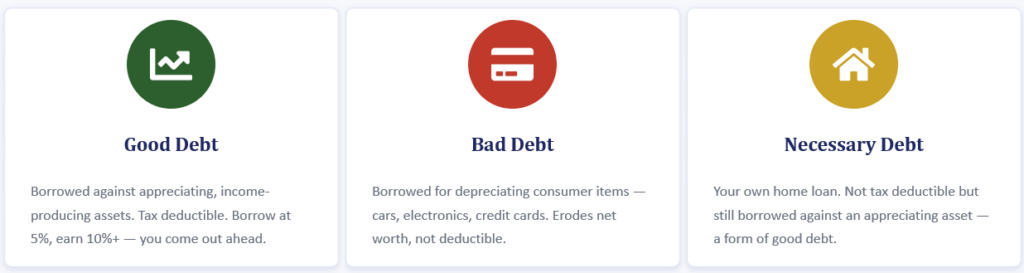
Despite what many of us were taught at school and by our parents, debt isn’t the enemy.
What matters is what you borrow for.
Why capital growth wins in the end
Take two 30-year-olds. One chases cash flow; the other chases capital growth. After 30 years, the growth investor could finish about 2.3 times further ahead.
Sure an extra $10,000–$20,000 a year in cash flow today would be beneficial, especially in today’s environment, but an extra $3 million in 30 years’ time, is life-changing.
The bottom line: know your numbers before you dip your toe in
We always prioritise safety and security when you invest, not disaster.
That comes down to a few principles:
- Get the order right, and treat tax benefits as a bonus, not the reason to buy
- Hold for the long term and let compounding do the heavy lifting
- Budget for every cost, model conservatively, and never raid your buffer
- Prioritise capital growth, use leverage wisely, and protect your borrowing capacity
The rules may be chopping and changing, but the investors who know their numbers will continue to surge ahead.
Want to go deeper? Our seminars in Brisbane, Sydney and Melbourne are just $39.99 and include a copy of the book.
And remember: property education like this may be tax-deductible, so ask your accountant. This article is general information only and doesn’t consider your personal circumstances. Speak with a licensed financial adviser, accountant or broker before making any investment, tax or lending decisions.